Voyager 1 Signals Now Take Over 22 Hours to Reach Earth, Engineers Left Waiting
Voyager 1 is now so far from Earth that it takes over 22 hours for signals to arrive, leaving engineers waiting nearly two days for a response.
Key Takeaways
- 1Voyager 1's distance from Earth now causes a 22-hour communication delay.
- 2Engineers must plan meticulously due to the significant wait for responses.
- 3The mission exemplifies both human achievement and the limits of technology.
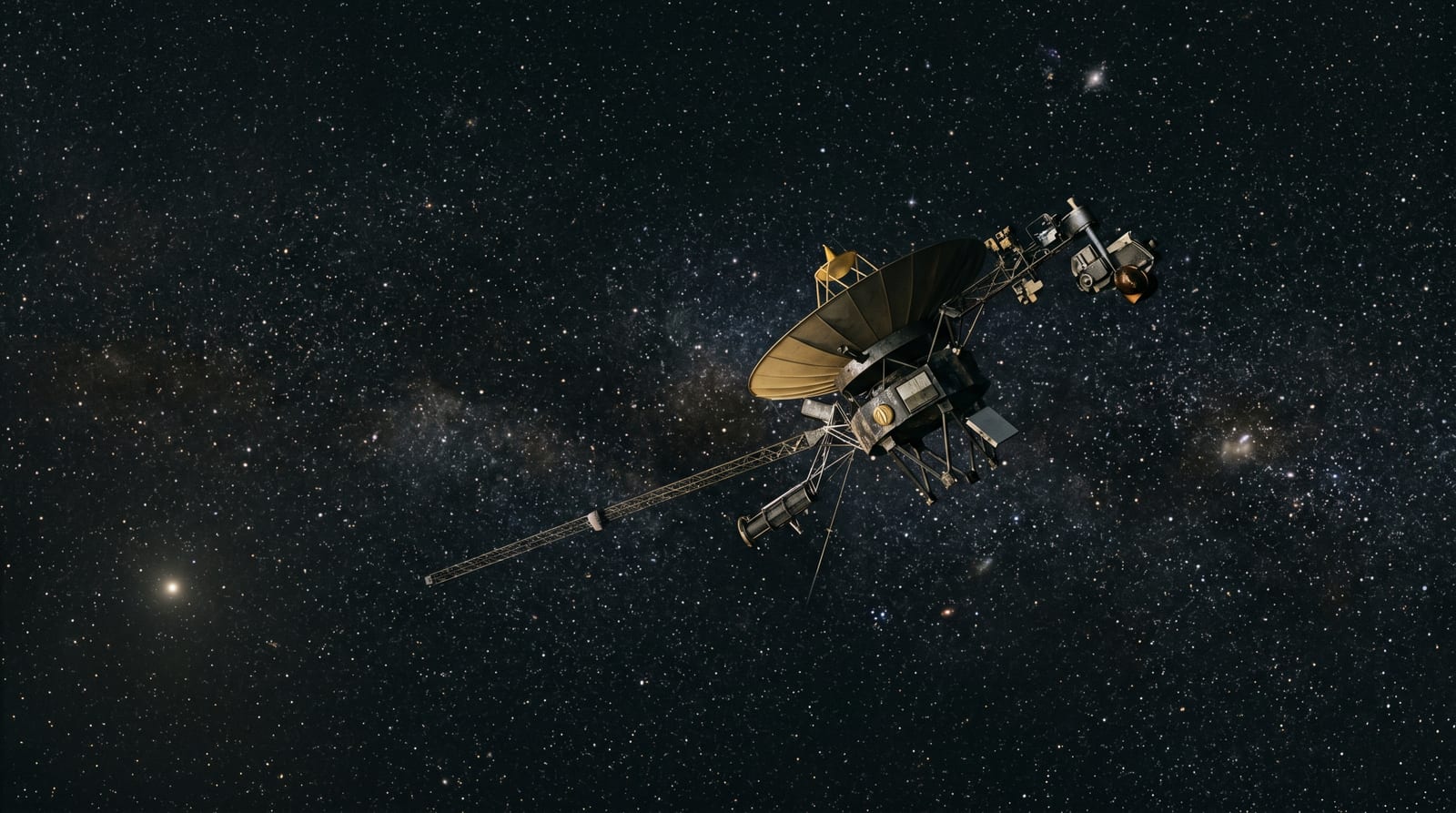
Voyager 1 is now approximately 14.8 billion miles from Earth, making communication a staggering challenge. The time it takes for a signal traveling at the speed of light to reach this spacecraft is now over 22.5 hours. When engineers send a command, they endure a nearly two-day wait to know whether the spacecraft has responded.
This delay is more than an inconvenience; it highlights the extreme conditions of interstellar exploration. As of now, Voyager 1 is the farthest human-made object from our planet, continuously sending data back from the edges of our solar system and beyond. The stakes are high: if something goes wrong, the response time required to troubleshoot could mean the difference between retrieving critical scientific data or losing it forever.
Launched on September 5, 1977, Voyager 1 was designed for a mission that would last a few years, studying the outer planets. Instead, it has outlived expectations, operating for over 48 years. As it ventured into deeper space, the distance from Earth grew exponentially. As of February 2026, engineers at NASA face the daunting reality of a 22.5-hour delay for signals, a significant leap from previous communication times.
Dr. Ed Stone, Project Scientist for Voyager, oversees the mission's scientific output. He acknowledges the operational challenges, describing how engineers must adjust their expectations in this age of slow communication. Each command sent to Voyager 1 is now a calculated risk; responses can take up to 45 hours, including the time it takes to receive feedback.
The implications of this delay are vast. Each command sent to the spacecraft requires meticulous planning, and engineers must be confident in their decisions. Mistakes could lead to missed opportunities for gathering data from the spacecraft, which continues to collect invaluable information about our universe.
Mainstream media often glosses over the profound implications of such communication delays. The reality is that Voyager 1 serves as a symbol of human ingenuity, yet it also showcases the limitations of our technology in the vastness of space. This isn't just about a long wait for a signal; it's about the risks involved in exploring the unknown. With each passing day, the challenges of operating Voyager 1 become more complex, raising important questions about the future of deep space exploration.
The next significant milestone occurs in 2026 when Voyager 1 is expected to reach a point one light-day from Earth. Engineers will continue to navigate the intricacies of long-distance communication, and the mission will remain a focal point for scientific discovery as it journeys farther into interstellar space.
Space Daily: Voyager 1 is now so far from Earth that a signal traveling at the speed of light takes more than 22 hours to reach it — so when engineers send a command, they can wait nearly two days to know whether the spacecraft responded - Space Daily
CNN: Voyager 1 will reach one light-day from Earth in 2026. Here’s what that means - CNN
WXXI News: The Little Probe That Could: Why Voyager 1 Matters, and Why NASA Just Switched Part of It Off - WXXI News
Ars Technica: Recoding Voyager 1—NASA’s interstellar explorer is finally making sense again - Ars Technica
Sources
- 01news.google.com — Voyager 1 is now so far from Earth that a signal traveling at the speed of light takes more than 22 hours to reach it — so when engineers send a command, they can wait nearly two days to know whether the spacecraft responded - Space Daily
- 02news.google.com — Voyager 1 will reach one light-day from Earth in 2026. Here’s what that means - CNN
- 03news.google.com — The Little Probe That Could: Why Voyager 1 Matters, and Why NASA Just Switched Part of It Off - WXXI News
- 04news.google.com — Recoding Voyager 1—NASA’s interstellar explorer is finally making sense again - Ars Technica
How does this story make you feel?
Thoughts? (0)
No comments yet. Be the first to share your take.
Liked this story?
Get Unfiltered in your inbox every morning.
Free · No spam · Unsubscribe anytime